

The Philippines further strengthened its engagement in regional higher education cooperation as Dr. Christine Nabor-Ferrer, Director IV of the Commission on Higher Education Regional Office 1 (CHED RO1), represented CHED in the 2025 ASEAN Advisory Committee and Conference for the ASEAN Cyber University (ACU) Project held in Seoul, Republic of Korea, on September 16 to 19, 2025.
The event, organized by the Korea Education and Research Information Service (KERIS) in partnership with the ASEAN Secretariat and the ASEAN University Network, served as a platform for advancing ASEAN–Republic of Korea collaboration in digital transformation, higher education innovation, and lifelong learning.
Dr. Ferrer joined delegates from ASEAN Member-states, the ASEAN Cyber University Steering Committee, and leading universities across the region in discussing policy directions and best practices that respond to the fast-evolving digital landscape of higher education.
The conference opened with remarks from Director Kwang-Hoon Jeong of KERIS, who emphasized the shared responsibility of ASEAN and Korea in shaping the future of education through digital transformation. Followed by a keynote speech from Mr. Kamal Mamat, Head of the Education, Youth, and Sports Division of the ASEAN Secretariat, who emphasized ASEAN’s vision of building a future-ready learning ecosystem rooted in inclusion, quality, and lifelong learning.
Throughout the plenary sessions, participants exchanged insights on innovative models of digital learning and regional cooperation.
Prof. Dr. Jintavee Khlisang of the Thailand Cyber University and Chulalongkorn University presented the Thai MOOC initiative as a model of inclusive lifelong learning. Her presentation also emphasized ASEAN–Korea collaboration in developing bilingual MOOCs, cross-border course sharing, and stackable learning pathways that enhance employability and regional mobility.
Dr. Andrew Adrian Pua of De La Salle University–Manila, discussed online course design as a creative avenue to improve traditional teaching, and Assoc. Prof. Dr. Thanapan Laiprakobsup, Executive Director of the ASEAN University Network, presented the AUN-QA frameworks as key mechanisms for strengthening quality assurance and qualifications comparability across ASEAN higher education institutions.
Beyond the plenary sessions, Dr. Ferrer actively participated in networking engagements with ASEAN delegates and Korean partners, particularly in discussions focused on enhancing the ASEAN–Korea Education Cooperation Framework through the Higher Education for ASEAN Talents Program and the ACU Open Educational Resources (OER) system.
Furthermore, she also joined conversations on policy harmonization, sustainability, and artificial intelligence literacy, contributing to emerging regional initiatives on digital credential verification and AI-driven learning ecosystems.
She noted that the insights gained from the conference are highly relevant to CHED’s policy agenda, especially in the areas of digital transformation, micro-credentials, and lifelong learning.
“The Philippine higher education sector must continue integrating digital indicators into institutional quality assurance systems and developing a national framework for stackable learning and micro-credential recognition,” Dr. Ferrer said.
She expressed gratitude for the opportunity to showcase Philippine initiatives and pledged to translate conference outcomes into actionable reforms at home.
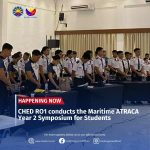
ATRACA Year 2 Symposium for Students
𝗛𝗔𝗣𝗣𝗘𝗡𝗜𝗡𝗚 𝗡𝗢𝗪 | CHED RO1 conducts the Maritime Advancements through Training and Collaboration Assembly (ATRACA) Year 2 Symposium for Students at J & V Resort and Hotel, Sevilla, City of San Fernando, La Union, October 10, 2025.
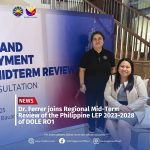
Dr. Ferrer joins Regional Mid-Term Review of the Philippine LEP 2023-2028 of DOLE RO1
In support of the national agenda to advance inclusive growth and strengthen workforce development, Dr. Christine Nabor-Ferrer, Director IV of the Commission on Higher Education Regional Office I (CHED RO1), participated in the Regional Mid-Term Review and Consultation on the Philippine Labor and Employment Plan (LEP) 2023–2028, at Hudor Resort, Bauang, La Union on October 10, 2025.
Led by the Department of Labor and Employment Regional Office 1 (DOLE R1), the event provided a platform to assess progress, recalibrate implementation strategies, and enhance collaboration among key stakeholders from both the public and private sectors.
The LEP 2023–2028 serves as the labor sector’s framework in alignment with the Administration’s socioeconomic agenda and the Philippine Development Plan (PDP). It focuses on three core pillars: the promotion of employment and human resource development, the protection and welfare of workers, and labor relations.
Dr. Ferrer’s participation emphasized CHED RO1’s efforts to ensuring that higher education remains responsive to labor market needs through the alignment of academic programs with employment trends and human capital development priorities.
Engr. Leonora Quarte, Education Supervisor II of CHED RO1 joined Dr. Ferrer during the said consultation.
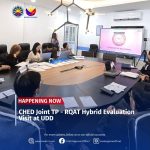
CHED Joint Technical Panel- Regional Quality Assessment Team Hybrid Evaluation Visit
𝐇𝐀𝐏𝐏𝐄𝐍𝐈𝐍𝐆 𝐍𝐎𝐖
CHED Joint Technical Panel- Regional Quality Assessment Team Hybrid Evaluation Visit at the Universidad de Dagupan for its Master in Education program in Dagupan City, Pangasinan, October 17, 2025.
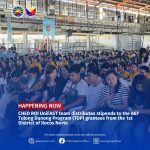
CHED ROI UniFAST team distributes stipends to the 867 Tulong Dunong Program (TDP) grantee
𝐇𝐀𝐏𝐏𝐄𝐍𝐈𝐍𝐆 𝐍𝐎𝐖
CHED ROI UniFAST team distributes stipends to the 867 Tulong Dunong Program (TDP) grantees from the 1st District of Ilocos Norte at Northwestern University, Laoag City, Ilocos Norte on October 16, 2025.

CHED ROI conducts Kalinga para sa Iskolar
𝐇𝐀𝐏𝐏𝐄𝐍𝐈𝐍𝐆 𝐍𝐎𝐖
CHED ROI conducts Kalinga para sa Iskolar, a holistic health and wellness program for the merit scholars, at the College of Medicine Building, DMMMSU South La Union Campus, Agoo, La Union on October 16, 2025.
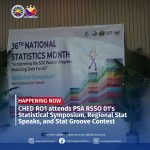
Philippine Statistics Authority RSSO 01’s Statistical Symposium
𝐇𝐀𝐏𝐏𝐄𝐍𝐈𝐍𝐆 𝐍𝐎𝐖
CHED ROI attends the Philippine Statistics Authority RSSO 01’s Statistical Symposium, Regional Stat Speaks, and Stat Groove Contest in celebration of the 36th National Statistics Month, with the theme “Accelerating the SDG Pace of Progress: Mobilizing Data for All,” on October 16, 2025, at J&V Resort Hotel, City of San Fernando, La Union
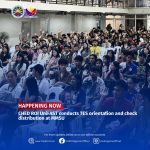
Tertiary Education Subsidy (TES) orientation and distribute 1,257 checks to Mariano Marcos State University grantees in Batac City
𝐇𝐚𝐩𝐩𝐞𝐧𝐢𝐧𝐠 𝐍𝐨𝐰
CHED UniFAST Regional Coordinators, supervised by Mrs. Catherine Chan, Education Supervisor II, conduct a Tertiary Education Subsidy (TES) orientation and distribute 1,257 checks to Mariano Marcos State University grantees in Batac City, Ilocos Norte, on October 15, 2025.
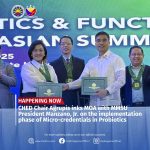
Implementation phase of Micro-credentials in Probiotics
𝐉𝐔𝐒𝐓 𝐈𝐍
CHED Chair Agrupis inks MOA with MMSU President Manzano, Jr. on the implementation phase of Micro-credentials in Probiotics, at Teatro Ilocandia-MMSU, Batac City, Ilocos Norte

Dr. Shirley Agrupis, CHED Chairperson, graces the 2nd Probiotics and Functional Foods Asian Summit
Dr. Shirley Agrupis, CHED Chairperson, graces the 2nd Probiotics and Functional Foods Asian Summit at Teatro Ilocandia, Mariano Marcos State University (MMSU) Main Campus, Batac City, Ilocos Norte, on October 15, 2025.
Also present at the event are CHED Office of Planning, Research and Knowledge Management (OPRKM) Director Sylvette Gunigundo and CHED Regional Office I Director Christine Nabor-Ferrer.